

Sophia Mittelbach, Florian Seida, Dominik Herrmann · Full Paper, ARES 2026, August 24–27, 2026, Linköping (Sweden) · Preprint to follow
Developed within the Bavarian research network ForDaySec.
Summary
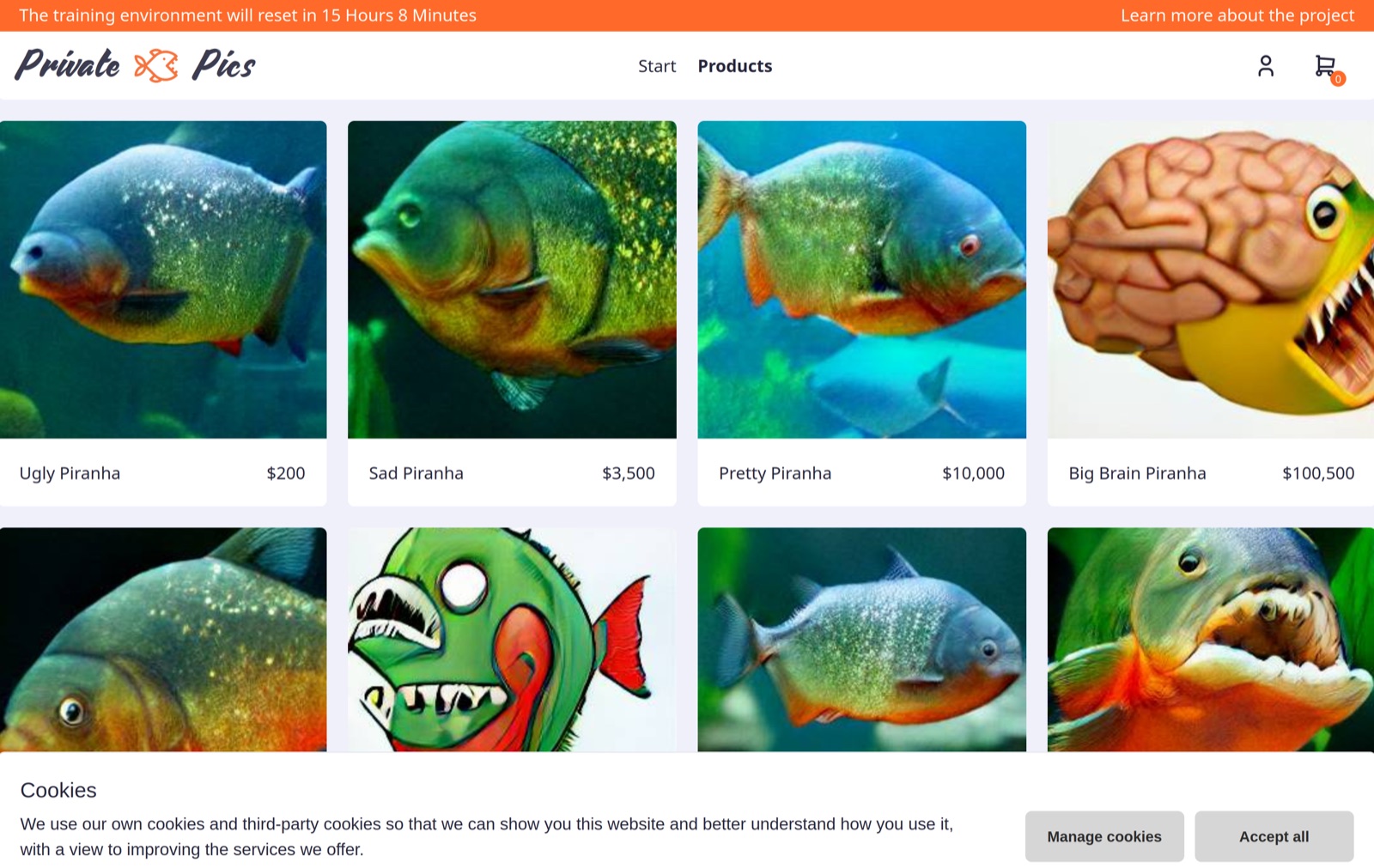
The Privacy Range transfers the principle of security training environments such as the OWASP Juice Shop to data protection: a realistic, fictitious online shop with 13 deliberately planted GDPR problems – from pre-enabled cookie toggles to forms that send input to third parties before submission. In a qualitative lab study (N = 10), IT students who had previously completed an intensive GDPR course taught by a practicing data protection lawyer searched for these problems while thinking aloud. The finding: the barrier was not missing conceptual knowledge but its procedural application – participants lacked investigative routines, fluency with the analysis tools, and the impulse to check what the interface claimed against what the system actually did.
Key findings
No audit script in mind
Participants investigated ad hoc and reactively rather than systematically – not out of inability, but because they lacked a practiced audit routine. Entire feature areas remained unexamined.
Believing instead of checking
UI feedback and policy statements were accepted as evidence: after deleting an account, hardly anyone looked for remaining data in public reviews. One participant put it plainly: “It’s a matter of believing rather than checking.”
Habituation makes problems invisible
Familiar non-compliant patterns (pre-enabled cookies, embedded Google Fonts) were no longer perceived as problems. Nobody found the extensive third-party tracking during free exploration.
Technical gaps for hidden problems
For problems requiring network or storage inspection, even targeted hints did not help (for three hidden problems: 0 of 4, 0 of 6, and 0 of 7 successful hint follow-ups).
Participants valued the environment less as a way to deliver knowledge than as a diagnostic instrument: “It really holds up a mirror to show you everything that’s still missing.” The consequence for education: legally focused GDPR instruction is necessary but insufficient on its own – “more training” of the same kind is the wrong answer. What is needed is training of procedural competence: structuring audits, verifying system behavior, and mapping observations to legal requirements.
The 13 planted privacy problems
| No. | Problem | Short description |
|---|---|---|
| V1 | Blocked privacy policy | The cookie banner blocks access to the privacy policy |
| V2 | Pre-enabled cookies | Toggles for optional cookies are switched on by default |
| V3 | Missing reject button | A “reject all” button is missing or hidden |
| V4 | Incomplete account deletion | After deletion, name and e-mail remain visible in public reviews |
| V5 | Storage limitation violated | Data is retained longer than necessary |
| V6 | Forced policy agreement | Agreement to the privacy policy is wrongly enforced as consent |
| M1 | Missing data export | No data portability function (legally debatable) |
| M2 | Incomplete privacy policy | Mandatory information on retention periods and purposes is missing |
| H1 | Scripts without consent | A hashtag button loads scripts and cookies without disclosure |
| H2 | Mislabeled consent | The cookie consent for a video is miscategorized |
| H3 | External fonts | Loading fonts from third parties transmits IP addresses |
| H4 | Extensive tracking | Third-party tracking, only visible after accepting optional cookies (legally debatable) |
| H5 | Leaky forms | Form input is sent to a third party before submission |
V = visible in the interface, M = missing functionality/information, H = only detectable via DevTools/source code. Most frequently recognized: H1 (all participants at least partially). Found by nobody during free exploration: H4.
Methods and limitations
Methods. Qualitative in-person lab study (N = 10, IT students, November 2025), about two months after a one-week intensive GDPR course (14 × 90 minutes taught by a practicing data protection lawyer, with a written exam – purely legal, no technical exercises). Procedure following the problem-solving-before-instruction paradigm: free exploration with think-aloud (max. 45 minutes), up to two hints per undiscovered problem, structured walkthrough, final interview. Analysis: reflexive thematic analysis (behavioral patterns), framework analysis with a pre-defined recognition rubric (weighted κ = .78), qualitative content analysis of the interviews (κ = .76).
Limitations. Small student sample from a single course at one institution; finding problems in an unfamiliar system is only a proxy for privacy competence in development; researcher presence and think-aloud may have influenced behavior and stated reasons; the findings relate to the specific selection of problems in the environment.
How to cite
Camera-ready version, DOI, and preprint to follow; for now:
@misc{mittelbach2026privacyrange,
  title  = {Beyond Theory: Identifying Barriers to Applied GDPR Compliance
            in a Privacy Range},
  author = {Mittelbach, Sophia and Seida, Florian and Herrmann, Dominik},
  year   = {2026},
  note   = {Accepted at ARES 2026; preprint forthcoming}
}
Source code of the Privacy Range, problem descriptions with design rationales, interview guides, hints, and the full recognition rubric are openly available: doi.org/10.5281/zenodo.20285016. A permanently available demo instance of the environment is in preparation.
Contact
Prof. Dr. Dominik Herrmann
Chair Privacy and Security in Information Systems
University of Bamberg, 96045 Bamberg
Chair Privacy and Security in Information Systems
University of Bamberg
96045 Bamberg
dh.psi@uni-bamberg.de | +49 951 863-2661
uni-mal-anders.de | LinkedIn
Prof. Dr. Dominik Herrmann
Chair Privacy and Security in Information Systems,
University of Bamberg, 96045 Bamberg
dh.psi@uni-bamberg.de
+49 951 863-2661
uni-mal-anders.de | LinkedIn